
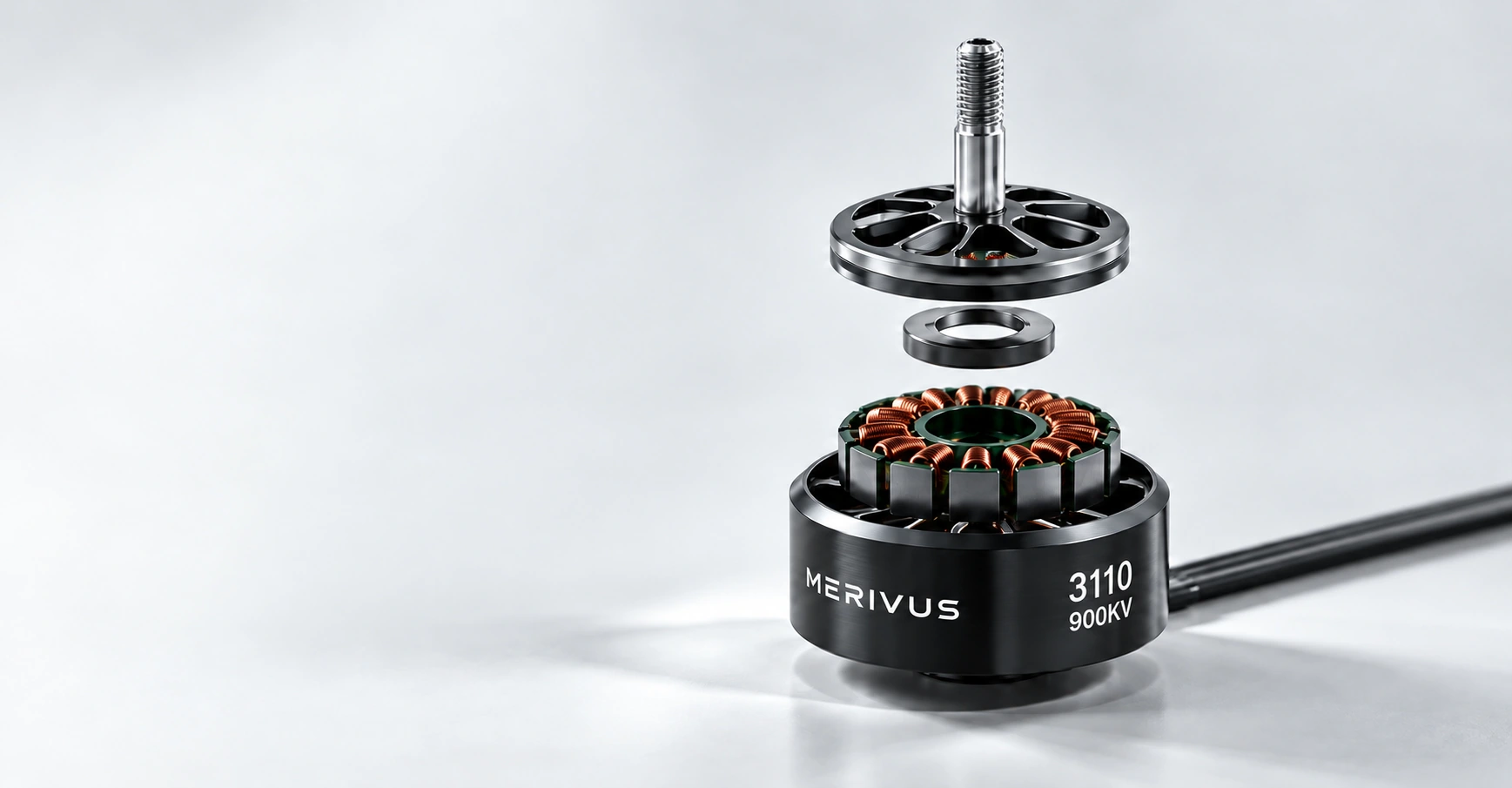
When choosing a brushless motor, should you start with KV or dimensions? Can the maximum thrust in a test table be used directly to select a complete aircraft system? A more useful sequence is to define the application, check the motor, power supply, ESC, propeller and mounting structure, then review data for the relevant operating conditions. This article uses existing MERIVUS models to explain those steps and help you prepare a more specific selection inquiry.
Define your requirements before shortlisting models
The same motor can face different mounting space, power supply and load requirements in different equipment. Product selection should therefore start with the project requirements. For an existing frame or propulsion system, list the constraints that are difficult to change. For a new project, record the goals and limits first, without committing to a model too early.
Start by describing the equipment's purpose, target propulsion performance, planned power supply, available mounting space and proposed propeller. If replacing an existing motor, also provide its model, dimensional drawing and current configuration, and explain the issue you want to address, such as a space mismatch or a change to propulsion configuration or wire routing.
You can contact us even if your information is incomplete. Record confirmed and open requirements separately so our technical team can identify what else is needed before discussing standard or custom options, reducing repeated model changes.
Understand KV rather than treating it as a quality score
KV, commonly expressed in rpm/V, describes the relationship between speed and voltage and can be used to estimate ideal no-load speed. This estimate does not account for actual load or losses and must not be treated as operating speed with a propeller. For the definition of the speed constant, see maxon's motor data guide.
When comparing products, KV is one specification that must suit the application. It is not a quality score and cannot on its own describe available thrust, continuous operation capability or complete aircraft performance. For models with different KV values, check their power supply specifications, dimensions and tested combinations rather than simply ranking the numbers.
For example, both the 2810 and 3110 in the product catalog have 900KV versions. Their weights, overall lengths and test propellers differ, so the same KV rating does not make them direct replacements.
Check the Power Supply, ESC and Propeller Together
Labels such as “6S” or “12S” are useful starting points, but must still be checked against the actual battery voltage and the documentation for each component. Evaluate the motor, ESC and propeller together; confirming one component’s label alone does not establish compatibility for the whole power system.
If you have already selected a battery, ESC or propeller, provide the exact model and specifications when contacting us. Check the ESC's supported supply, control interface and operating conditions against its documentation. Provide the complete propeller model too, since diameter alone does not describe differences in pitch and structure.
Results from a specified test combination apply only to that combination and the stated conditions. If the propeller, power supply or other configuration changes, the table's current and thrust values cannot be carried over unchanged. If the documentation does not cover your setup, identify the missing compatibility information and validation evidence rather than assuming a definite result from a similar model.
Both 900KV: Compare Mounting and Weight First
Begin checking mechanical compatibility with the outer diameter, overall length, shaft diameter and mounting-hole specifications. The following comparison uses 2810 900KV and 3110 900KV as examples. All weights in the table include wires, allowing comparison on the same basis.
| Items to check | 2810 900KV | 3110 900KV |
|---|---|---|
| Weight including wires | 65.15g | 81.78g |
| Outer diameter (approx.) | Ø33.2mm | Ø37mm |
| Overall length | 39.2mm | 41.2mm |
| Shaft diameter | 5mm | 5mm |
| Mounting hole specification | 4-M3 | 4-M3 |
| Test propeller listed in the documentation | HQ MQ9×4.5×3 | HQ10×5×3 |
Even if both models specify 4-M3, check the full engineering drawings for hole spacing, shaft-end shape, mounting position and clearance. Matching hole counts and thread sizes do not confirm direct frame compatibility, and product images cannot replace dimensional information.
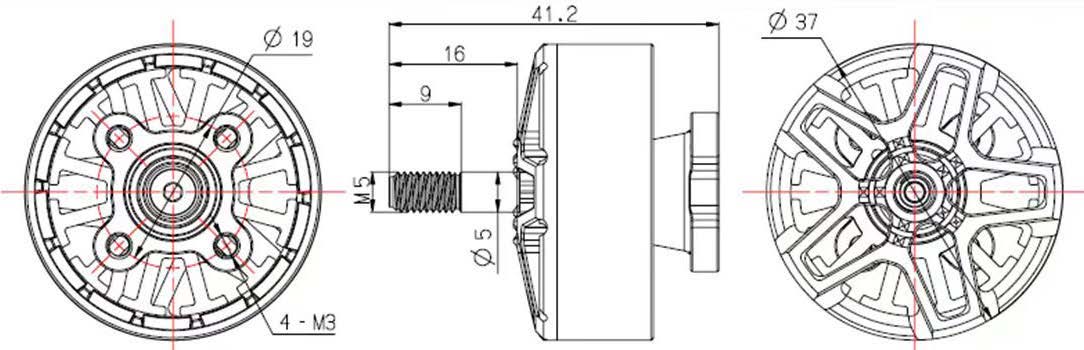
The engineering drawing illustrates what to check. Before assembly, confirm the complete dimensional documentation for the specific sales model.
Read Test Conditions Before Current and Thrust
In a propulsion test table, first identify the power supply, actual voltage, propeller and throttle setting. Then read current, thrust and speed in the corresponding row. Taking only the final row or the largest number removes the conditions needed to interpret the result and cannot establish performance in other operating conditions.
For example, 4125 490KV has a confirmed current measurement of 70.48A, recorded under 6S supply, GF 15×8E propeller, 100% throttle and a measured voltage of 23.46V. This is a record for specific test conditions. It cannot be presented as a continuous current rating or used alone to determine ESC configuration or long-term operating capability.
Likewise, test thrust is not an aircraft payload guarantee. Propellers, power supply, altitude and ambient temperature can affect the results. Test duration, cooling conditions and aircraft performance not specified in the documentation require further confirmation; a single peak value cannot establish them.
When comparing candidate models, first mark the data as “same conditions,” “different conditions” or “insufficient information.” This shows which values can be discussed under equivalent conditions and which require more information, rather than producing a performance ranking detached from operating conditions.
Use This Checklist for a More Specific Inquiry
Include the following information with your inquiry to reduce follow-up questions. Mark any undecided items as “to be assessed”. If available, also provide the existing configuration, engineering drawings or component specifications.
- Application & TargetsEquipment purpose, propulsion targets, existing configuration and the problem you want to solve.
- Power Supply & ComponentsBattery configuration, proposed ESC and full propeller model, with any available component documentation.
- Mounting & SpaceFrame drawings, hole locations, shaft-end requirements, available space and wire routing requirements.
- Purchasing and deliveryPurchase quantity, target delivery date, standard or custom requirements and the accessories to be included.
美利威瑟(温州)工业科技有限责任公司 can discuss product selection and integration needs based on the available product documentation. Start by comparing models in the Brushless Motors category, then use Contact MERIVUS to submit your information. For an overview of the series, read Introduction to the MetaDrive product range.
Product selection FAQ
Are motors with the same KV directly interchangeable?
KV alone is not enough. Check dimensions, weight, mounting holes, shaft end, power supply and propeller combination. The 900KV versions of the 2810 and 3110 differ in weight and dimensions.
Does a 6S specification mean any 6S ESC and propeller will work?
That label alone does not establish compatibility. Check the specific battery, ESC and propeller documentation together with the motor’s configuration and operating conditions.
Can 70.48A be treated as the continuous current rating of the 4125?
No. It is a test record for the specific power supply, propeller, throttle and voltage stated above. It cannot establish a continuous rating or sustained operating capability.
Can I make an inquiry without complete frame drawings?
Yes. Start by sharing the application, existing component models, available space and goals, and identify anything still undecided. Mounting interfaces and the supply configuration will still need to be confirmed during selection.
Model specifications are based on product information verified by MERIVUS and the MetaDrive product manual. The 4125 current figure uses the confirmed record for the specified operating conditions. The explanation of KV refers to the official maxon source linked above. This article outlines a selection process; actual configuration, compatibility and scope of supply are subject to the relevant product documentation and technical confirmation by both parties.